
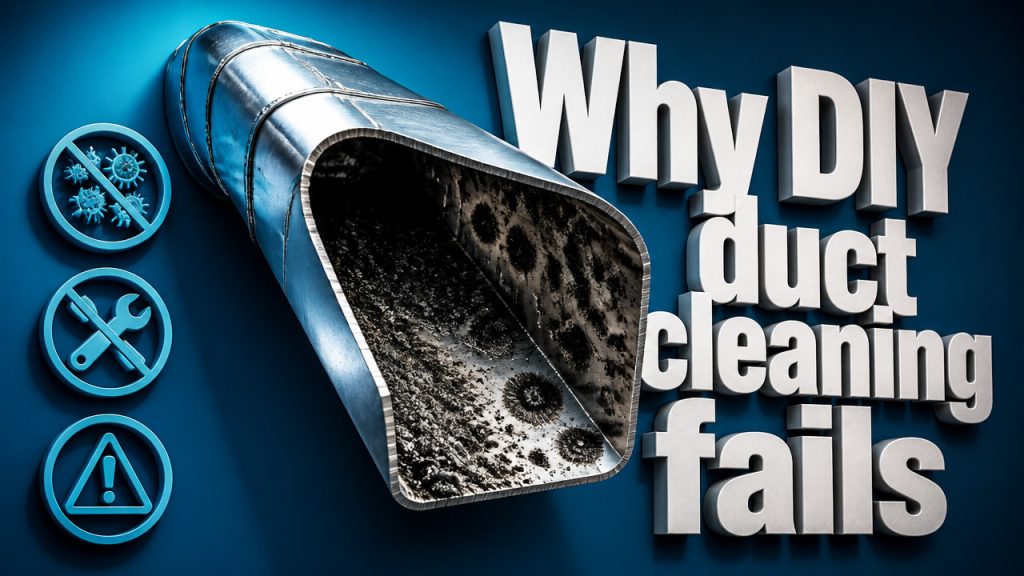
When mold colonizes your ductwork, you’re facing a decision that affects your family’s health, your home’s air quality, and your wallet. Professional mold removal in ductwork achieves a 95-98% eradication rate using EPA-approved antimicrobials and specialized equipment, while DIY attempts typically reach only 40-60% effectiveness and risk spreading spores throughout your home. The difference isn’t just in results it’s in safety protocols, equipment access, and long-term prevention strategies that determine whether mold returns in months or stays gone for years.
Quick Answer: When Professional Mold Removal Beats DIY Every Time
Not every mold situation requires a professional team, but most ductwork contamination does. The tipping point hits when mold covers more than 10 square feet or when it has penetrated deep into your HVAC system’s internal components. For families with babies, elderly members, or anyone with respiratory conditions, that threshold drops to essentially zero. Any visible mold in your ductwork warrants professional assessment.
Surface mold on accessible vents might respond to homeowner cleaning, but ductwork presents unique challenges. The porous insulation inside your air handler, the tight bends in your return lines, and the hidden evaporator coils all create perfect hiding spots for mold colonies. DIY methods clean what you can see, leaving the actual infestation intact and ready to recolonize within weeks.
Professional duct mold remediation succeeds where DIY fails because it addresses the entire system, not just visible growth. Source identification, moisture elimination, containment protocols, and antimicrobial treatment combine to deliver lasting results. Here’s how the approaches stack up:
| Metric | Professional Service | DIY Approach |
|---|---|---|
| Success Rate | 95-98% eradication | 40-60% surface only |
| Cost (Austin 2026) | $800-$1,500 typical | $89-$400 supplies |
| Time Required | 4-8 hours (team) | 2-3 days (homeowner) |
| Safety Protocol | Full containment, PPE | Limited protection |
| Warranty | 1-5 year guarantee | No coverage |
The numbers tell the story, but they don’t capture the hidden risks. A botched DIY job can turn a localized problem into a whole-house contamination event. One wrong move with inadequate equipment sends millions of spores circulating through your living spaces, settling into carpets, bedding, and lungs. For Austin homeowners serious about healthy indoor air, specialized mold cleaning services deliver peace of mind that hardware store solutions simply cannot match.
The Hidden Costs: Why $89 DIY Kits Cost More Than $800 Professional Jobs
That $89 mold removal kit looks tempting on the shelf. It promises professional results at a fraction of the cost. But the sticker price tells only a tiny part of the story. When Austin homeowners calculate the true cost of DIY HVAC mold treatment, most discover they have actually spent more than hiring experts from the start.
The math works out when you factor in everything. Rental equipment for proper containment runs $150-$300 per day. Personal protective equipment that actually works, not the flimsy masks included in kits, adds another $75-$150. Antimicrobial solutions strong enough to kill mold at the root cost substantially more than the spray bottles included in retail packages. And none of this accounts for your time, which most homeowners dramatically underestimate.
DIY attempts also carry real financial risks that don’t appear on any receipt. spreading contamination can transform a single-room problem into a whole-house remediation project costing $3,000-$7,000. Amateur removal attempts often void HVAC manufacturer warranties, leaving you responsible for any system damage. Insurance claims frequently deny mold damage from homeowner attempts, while professional work typically qualifies for coverage.
Understanding air duct fungus removal costs means looking past the initial receipt. Here’s what most DIY guides don’t mention:
- Equipment rentals: $150-$300 daily for inadequate consumer-grade tools
- Personal protective equipment: $75-$150 for proper respirators and suits
- Antimicrobial solutions: $80-$200 for effective concentrations not sold in stores
- Contamination spread repair: $2,000-$5,000 if spores colonize additional areas
- HVAC system damage: $500-$2,500 for corroded coils or damaged insulation
- Your labor hours: 16-24 hours typically versus 4-8 hours for a professional team
The economics of DIY only work if everything goes perfectly, which it rarely does with mold. One missed colony, one inadequate seal, one wrong pressure setting, and you are facing costs that dwarf professional pricing. For Central Texas homeowners who want the job done correctly the first time, contamination removal science provides a roadmap that amateur methods cannot replicate.
Equipment Gap: Why Your Shop Vac Can’t Match Industrial HEPA Systems
The equipment difference between professional and DIY mold removal isn’t just about power or price. It’s about physics. Consumer-grade vacuums and cleaning tools fundamentally cannot achieve the particle capture rates and containment standards that ventilation system mold remediation requires. The gap isn’t closable with better technique or more effort.
Professional HEPA vacuum systems used for ductwork mold cleaning pull 2,500-4,000 cubic feet per minute (CFM) while maintaining 99.97% capture of particles down to 0.3 microns. Your shop vac moves maybe 150-200 CFM with filters that catch visible debris but pass mold spores right through. That difference matters enormously when you are trying to remove microscopic particles from a complex duct network.
Negative air pressure containment is possibly the most critical equipment difference. Professionals set up sealed containment zones with HEPA-filtered negative air machines that create pressure differentials preventing spore escape. DIY attempts have no way to create or maintain this containment. You end up pulling mold through the system while blowing spores into your living space with every pass.
The particle capture numbers reveal the truth about AC duct mold elimination equipment:
Consumer vacuums capture particles larger than 10 microns reasonably well. But mold spores range from 1-20 microns, with many species producing spores in the 2-5 micron range. Professional HEPA systems catch these tiny particles. Your shop vac recirculates them into your air supply, thickening the contamination with every pass.
Negative air machines create the pressure differentials that professionals use to seal off contamination zones during air handler mold service. These units maintain 0.02 inches of water column negative pressure, ensuring airflow moves into the work area rather than out into your home. No consumer equipment can create or maintain this pressure differential. When you clean mold with a shop vac, you are essentially pressure-washing your contamination into every corner where your HVAC system reaches, which is everywhere.
For homeowners interested in thorough residential duct cleaning techniques, understanding equipment limitations helps explain why professional results differ so dramatically from DIY attempts.
Detection Accuracy: Professional Air Quality Testing vs Visual Inspection
There’s an old saying that you don’t know what you don’t know. That pretty well describes the difference between DIY visual mold inspection and professional detection methods. You can see surface mold on a vent cover. You cannot see mold growing inside insulated ductwork, behind evaporator coils, or in the plenum box where your air handler connects to your distribution system.
Professional detection methods for return vent mold treatment start with visual inspection but go much further. Air sampling captures spores circulating through your system, which are then analyzed in laboratories to identify species and concentration levels. Surface sampling detects growth that is not yet releasing significant spore counts but will bloom under the right conditions. Moisture mapping identifies the conditions that support mold growth before colonies establish themselves.
| Detection Method | Accuracy Rate | What It Misses |
|---|---|---|
| DIY Visual Check | 20-30% of problems | Hidden growth, early-stage colonization, interior duct surfaces |
| DIY Test Kits | 40-50% accurate | Location of growth, species identification, concentration levels |
| Professional Visual | 60-70% of problems | Deep system contamination without surface signature |
| Professional Air Quality Test | 95-98% accuracy | Very early colonization before spore release begins |
DIY test kits give you a snapshot, but they do not give you the full picture. A petri dish sitting in your living room tells you mold exists somewhere. Professional testing pinpoints exactly where, identifies exactly what species, measures exactly how concentrated the contamination is, and determines exactly what conditions are supporting growth. For air quality improvement methods that actually work, this precision matters.
How Professional Mold Removal Protects Your Family in 4 Critical Phases
Professional mold removal follows a systematic process that addresses not just existing contamination but the conditions that allowed it to develop. Each phase builds on the previous one, creating a comprehensive approach that DIY methods cannot match. Here is what separates professional protocols from amateur attempts.
Phase 1: Containment and Safety Setup
Before any removal begins, professionals seal off the work area with plastic sheeting and establish negative air pressure using HEPA-filtered equipment. This prevents spores from escaping into your living spaces during cleaning. Technicians wear full personal protective equipment including respirators, not the inadequate paper masks sold at hardware stores. For families with babies or allergy sufferers, this containment phase is critical. It ensures that the removal process itself doesn’t expose your family to concentrated spore loads.
Phase 2: Removal and Physical Cleaning
Using specialized HEPA vacuum equipment and mechanical brushes, professionals physically remove mold colonies and contaminated materials from your ductwork. This phase addresses visible growth and hidden deposits in bends, connections, and insulated sections. Consumer equipment cannot match the suction power or particle capture needed for effective removal.
Phase 3: Antimicrobial Treatment and Disinfection
After physical removal comes chemical treatment with EPA-registered antimicrobials specifically designed for HVAC systems. These solutions kill remaining spores and create residual protection against regrowth. UV light HVAC disinfection may be installed as a permanent solution, providing ongoing antimicrobial action that prevents future colonization.
Phase 4: Moisture Source Elimination and Prevention
Perhaps most importantly, professionals identify and address the moisture source that allowed mold to grow. Without this step, mold returns within months regardless of how thoroughly you clean. Leaky ducts, condensation problems, or humidity issues must be resolved to prevent recurrence.
Professional protocols include steps that DIY methods skip entirely:
- Negative air pressure containment setup before removal begins
- Full respiratory protection with properly fitted respirators
- HEPA vacuum equipment rated for mold spore capture
- Mechanical agitation to remove growth from duct surfaces
- EPA-registered antimicrobial application with proper dwell times
- Moisture source identification using thermal imaging cameras
- Post-treatment air quality testing to verify success
- Warranty documentation guaranteeing results
Central Texas Climate Factor: Why Austin Humidity Demands Expert Solutions
Austin’s climate creates perfect conditions for mold growth in HVAC systems. Our region averages 68% relative humidity throughout the year, with summer months regularly exceeding 80%. Ductwork systems in Central Texas homes face continuous moisture exposure that makes mold removal in ductwork particularly challenging and recurrence particularly common.
The physics of air conditioning contribute to the problem. Cool ductwork surfaces in warm, humid environments create condensation. This moisture collects in duct insulation, drain pans, and around evaporator coils. Even small amounts of standing water or consistently damp surfaces support mold colonization within 24-48 hours of spore contact.
Austin’s mold species are particularly aggressive. Our warm, humid climate supports rapid growth cycles, meaning colonies establish faster and spread further than in drier climates. What might take weeks to become a problem in Arizona can develop in days in Central Texas. This rapid growth means detection windows are shorter and recurrence rates are higher without proper remediation.
Local expertise matters for effective duct mold remediation in Austin. Noble Air technicians understand Central Texas climate patterns, common construction methods in local homes, and typical moisture problem points in regional HVAC installations. Austin-area duct services account for our unique environmental factors in ways that generic guides cannot.
Insurance and Warranty: The Coverage Gap DIY Can’t Close
When mold removal goes wrong, the financial consequences extend well beyond the initial cleaning cost. DIY attempts create liability issues that professional services address through insurance and warranty protection. The coverage gap between amateur and professional work can mean thousands of dollars in difference when problems arise.
Professional mold remediation companies carry liability insurance specifically covering mold-related work. If something goes wrong during the cleaning process, coverage exists for both your property and the technicians. DIY attempts have no such protection. Any damage to your HVAC system, any contamination spread, any health effects from improper removal, all fall entirely on you.
Warranties tell a similar story. Professional services typically guarantee their work for 1-5 years, with some offering lifetime warranties against recurrence when combined with preventive measures. If mold returns within the warranty period, the company returns to resolve the problem at no additional cost. DIY attempts come with exactly zero warranty protection. When mold returns in three months, you start over from scratch.
Forair duct cleaning insurance protection, professional documentation matters for claims. Insurance companies require evidence that work was performed by qualified professionals using appropriate methods. DIY attempts may actually void coverage for subsequent mold damage.
Key Takeaways: Making the Right Mold Removal Decision
The choice between professional and DIY mold removal in ductwork comes down to effectiveness, safety, and long-term value. Professional services cost more upfront but deliver results that last. DIY attempts require significant investment in time and equipment while delivering uncertain outcomes and genuine risks. You should make the choice based on several key factors:
- Contamination extent: More than 10 square feet or hidden growth requires professionals
- Health considerations: Any family member with respiratory issues or compromised immunity demands professional-grade removal
- System complexity: Homes with multiple HVAC zones, complex ductwork configurations, or older systems benefit from professional assessment
- Climate factors: Central Texas humidity makes recurrence likely without professional moisture management
- Value of time: DIY requires 16-24 hours of homeowner labor versus 4-8 hours for a professional team
Noble Air provides Austin homeowners with comprehensive comprehensive air duct cleaning guide services that address mold contamination thoroughly and safely. Local expertise, professional equipment, and systematic protocols deliver results that protect your family’s health and your home’s air quality for years rather than weeks.
FAQ: Mold Removal in Ductwork Questions Austin Homeowners Ask
Can I remove mold from ductwork myself without professional help?
No, not effectively. DIY methods typically achieve only 40-60% removal rates compared to 95-98% for professional services. The equipment gap and containment protocols make thorough DIY duct mold remediation essentially impossible for homeowners.
How much does professional duct mold removal cost in Austin?
Typically $800-$1,500 for standard homes. Complex systems or severe contamination can reach $3,000, but this compares favorably to the $2,000-$5,000 cost of correcting botched DIY attempts that spread contamination.
How long does professional duct mold removal take?
Four to eight hours for most homes. Professional teams work efficiently because they have proper equipment and experienced technicians. DIY attempts typically require 16-24 hours spread across multiple days.
Is duct mold dangerous for babies and children?
Yes, potentially very dangerous. Young children have developing respiratory systems that are particularly vulnerable to mold exposure. Any visible mold in ductwork serving nurseries or children’s rooms warrants immediate professional residential duct cleaning services.
Will mold return after professional removal?
Unlikely with proper moisture management. Professional removal includes addressing the moisture source that allowed growth. With moisture control, recurrence rates drop below 5%. With proper preventive measures like UV light systems, even that small recurrence risk drops further.
Does homeowner’s insurance cover duct mold removal?
Often yes, for professional services. Many policies cover mold remediation when performed by qualified professionals. DIY attempts may actually void coverage for subsequent mold damage, creating financial liability the homeowner bears entirely.
If you suspect mold in your Austin-area home’s ductwork, contact Noble Air for a professional assessment. Your family’s health deserves the protection that proper remediation provides.