
To remove smoke smell from house interiors permanently, you have to clear three layers: ventilate and replace filters, wash every porous surface, and clean the HVAC ducts that keep recirculating residue. Candles and air fresheners only mask the problem. Smoke particles settle into drywall, upholstery, and ductwork, then release odor every time your system runs. This guide shows the sequence that works, why the order matters, and when Austin homeowners should call a professional.
Quick Answer: Smoke Odor Leaves Only When Surfaces, Filters, and Ducts All Get Cleaned
Smoke odor does not float away on its own. It sticks, bonds, and hides in places you cannot see. If you want to actually remove smoke smell from house air, you have to hit every contamination point in the right order. Sprays and candles fail because the source stays put. The smoke particles settle into your carpet, your curtains, and crucially, your ductwork, then release that odor every single time your HVAC kicks on. Real eliminating indoor odors through duct cleaning means attacking the root cause, not the symptom.
- Ventilate the space with open windows and fans to flush particulates
- Clean every washable surface, walls, ceilings, and hard floors
- Launder or dry-clean all soft goods like curtains and upholstery
- Clean HVAC ducts and replace all air filters with fresh units
Why Smoke Smell Outlasts the Fire: Sticky Particulates Bond to Porous Materials
That lingering campfire smell is not just in your head. It is chemistry. Smoke carries a cocktail of particulate matter, volatile organic compounds, and sticky residues like creosote and tar. When those particles cool, they do not disappear. They land. They bond. They settle into your drywall, your insulation, and your furniture, creating a reservoir of odor that can last for years.
[Analysis] EPA guidance on fine particles confirms that these particulates penetrate deep into indoor environments, settling in dust and on surfaces where they can be resuspended by normal activity. The agency notes that fine particles can remain airborne for extended periods and infiltrate homes through cracks, vents, and open windows, embedding themselves in the indoor environment long after the initial smoke event passes.
Think of smoke particles like glitter. Once it is in your carpet, it is there forever unless you actively remove it. The difference is that glitter is inert. Smoke particles, especially those from cigarettes or burning plastic, contain oils and resins that actively bond with porous materials. That is why a quick wipe-down does not cut it. The residue has already soaked into the paint, the duct lining, and the fabric fibers. Professional deep cleaning your air ducts for a healthier living space targets the reservoirs you cannot reach with a sponge.
| Smoke Source | Primary Residue Type | Odor Persistence Level |
|---|---|---|
| Cigarette/Tobacco | Tar, nicotine oils, ammonia compounds | High bonds permanently to paints and fabrics |
| Kitchen/Grease Fire | Animal fat, polymerized oils, soot | Medium-High sticky residue resists basic cleaning |
| Wildfire/Brush | Cellulose ash, creosote, potassium | Variable depends on humidity and surface type |
| Fireplace/Chimney | Creosote, soot, wood tars | High reactivates in humid or damp conditions |
The 7-Step Smoke Odor Removal Sequence, in the Order That Actually Works
Ready to get smoke smell out of house air for good? You have to follow the sequence. Working out of order wastes effort. For example, cleaning ducts before you scrub the walls means the settled dust just gets pulled right back into your newly cleaned system. Work clean first, deodorize second, and always move from the top of the room down.
Watch for the warning signs early. Recognizing signs your air ducts need cleaning can save you from recirculating smoke particles through your home for months on end.
- Ventilate thoroughly first. Open all windows and set up box fans to create cross-breeze pressure. Flush the house with fresh air for at least 24 to 48 hours before deep cleaning.
- Replace every HVAC filter. Your old filters are saturated with smoke particles. Remove them immediately to prevent the system from pulling trapped odors back into your living space.
- Scrub hard surfaces top-down. Walls, ceilings, trim, cabinets, and hard floors. Use a detergent with a degreaser to cut through the oily smoke residue. Start high and work down.
- Launder all soft goods. Curtains, bedding, throw blankets, and removable cushion covers need a wash cycle with an odor-fighting detergent. Some items may require professional dry cleaning.
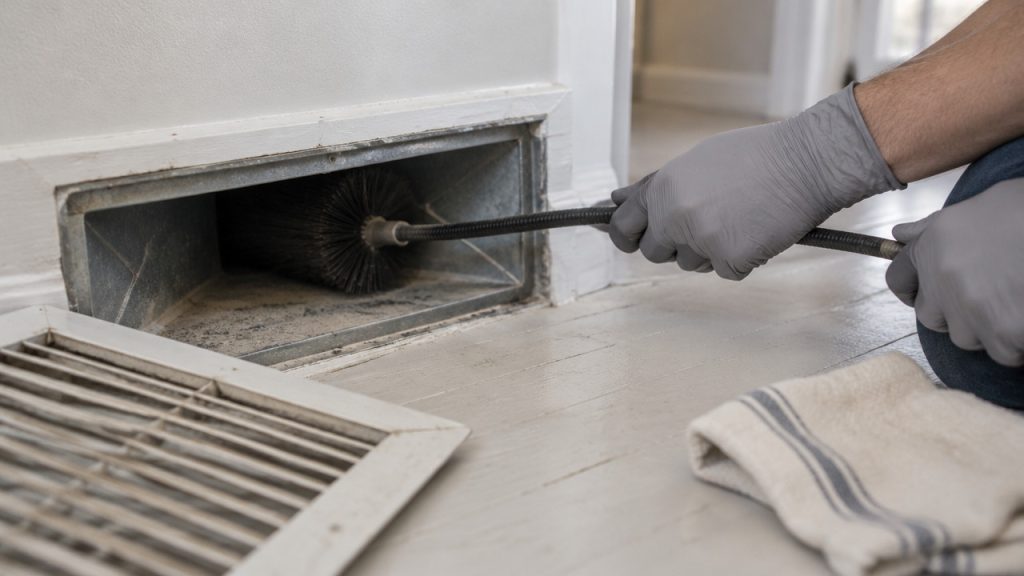
- Clean the HVAC ductwork. This is the step most homeowners skip. Ducts collect smoke residue that releases odor every time the fan runs. Professional cleaning removes the hidden reservoir.
- Steam clean carpets and upholstery. Deep extraction pulls embedded particulates out of carpet fibers and sofa fabric that surface cleaning cannot reach.
- Apply sealed primers and paint. If odors persist after cleaning, apply a stain-blocking primer to walls and ceilings before repainting. This seals any remaining microscopic residue.
A quick note on baking soda and activated carbon. These products have their place. Bowls of baking soda can absorb minor ambient odors for a few days. Activated carbon filters help trap particulates in your HVAC system. However, neither product can eliminate the source of a deep-set smoke odor. They are supplements, not solutions. If you still smell smoke after step seven, the residue is likely hidden somewhere you have not treated, probably inside your ductwork or attic insulation.
Your HVAC System Is the Odor Superhighway, So Treat It Before You Repaint
You can scrub your walls until your arms give out. If your ducts are still dirty, that effort goes out the vent. Your HVAC system acts as a massive distribution network for odor. The return vents pull air from your rooms, sucking in smoke particles along with it. Those particles stick to the duct walls, the blower wheel, and the evaporator coil. When the system turns on, it pushes that contaminated air right back into your living room, bedroom, and kitchen.
This is why homeowners often report that the smoke smell gets worse when the AC or heat turns on. The system is actively re-releasing the odor from its internal reservoir. Professional professional air duct cleaning breaks the cycle. Technicians use high-powered vacuums and agitation brushes to dislodge debris from the duct walls, then extract it before it can circulate again.
- Visible soot around supply or return vent registers Black staining means particles are blowing out.
- Odor intensifies when the HVAC fan runs A clear sign that residue resides inside the ducts.
- Clogged or dirty filter despite recent replacement Duct debris rapidly loads new filters with particulates.
- Musty or smoky smell from vents when heat kicks on Heat re-volatizes residue on the heat exchanger or coils.
- Increased allergy symptoms at home Irritants in the ducts circulate continuously, triggering coughs and sneezes.
Fireplaces and Dryer Vents: The Two Sneaky Smoke Reservoirs Most Homeowners Miss
One evening you light a fire. The next morning, a damp, smoky smell lingers in the living room. That is rehydrated creosote, a byproduct of wood combustion that coats the inside of your chimney. It creates a tar-like residue that smells faint when dry but releases a potent odor when humidity rises. Central Texas gets humid. That means your chimney can act as a passive odor emitter for months after the last fire, especially during rainy stretches in the spring and fall.
Dryer vents present a similar, often overlooked problem. Lint traps do not catch everything. Fine particulates pass through and accumulate in the dryer vent duct. If you have had a kitchen mishap with smoke, that residue can migrate into the dryer vent when the fan runs. Over time, the buildup restricts airflow and creates a reservoir for odors. Knowing signs your home needs professional chimney service and keeping your dryer vent clear removes both hidden sources before they contribute to a lingering smoke problem.
- Chimney and fireplace Creosote and soot buildup reactivates in humidity. Fix: Annual chimney inspection and professional sweeping.
- Dryer vent duct Accumulates lint and fine particulates, triggering odors and fire risks. Fix: Annual professional dryer vent cleaning.
- Attic insulation Porous insulation traps smoke particles from ceiling leaks or attic HVAC units. Fix: Inspect and replace insulation after major smoke exposure.
Central Texas Reality Check: Wildfire Haze, Cedar Burns, and Humidity Make Odors Return
Austin homeowners face a specific set of environmental challenges. The region sees regular smoke events from Central Texas cedar burns in winter and wildfire haze drifting in from the Hill Country or farther west in spring and summer. Even if a fire stays miles away, the wind carries microscopic particles right into your attic vents, your fresh air intake, and your open windows. Once inside, the humidity typical of Central Texas reactivates the odor.
That sticky summer air acts like a solvent for the microscopic residue on your duct walls. The moisture helps the particles release their volatile compounds, and your HVAC system spreads them throughout the house. Residents seeking air duct cleaning in Austin, TX often schedule service after these major smoke events because they notice the smell returning when the humidity spikes.
- Controlled cedar burns (Winter) Clean ducts and replace filters immediately after a heavy burn day in your area.
- Wildfire haze events (Spring/Summer) Close all windows and fresh air intakes during the event. Schedule duct cleaning after air quality improves.
- Humidity spikes (Year-round) Install a whole-home dehumidifier to reduce moisture and prevent reactivation of embedded odors.
- Post-storm mold and mildew Wet insulation in attics or crawlspaces can harbor smoke and mold odors. Inspect after heavy rain.
Key Takeaways: What Fixes Smoke Smell and What Just Wastes Your Weekend
Cutting through the noise takes effort. The internet offers a thousand hacks for smoke odor removal. Vinegar bowls. Onion slices. Coffee grounds. Most of these tactics provide temporary masking at best. Real elimination requires chemistry, physics, and a deliberate sequence. Clean the source before you deodorize the air. Prioritize your air handler and ducts as the primary distribution point. If you have babies, allergy sufferers, or elderly family members in the home, the urgency increases. Their respiratory systems face greater risk from the particulate matter smoke leaves behind.
- Clean before you deodorize. Removing the residue stops the odor. Masking it only works until the scent fades.
- Replace filters immediately. Saturated filters recirculate trapped smoke particles every cycle.
- Ductwork is critical. Your HVAC system distributes odor. Clean it or the smell returns.
- Porosity matters. Drywall, carpet, and insulation hold odor longer than hard surfaces.
- Humidity wakes up residue. Moisture reactivates creosote and soot, especially in Texas climates.
- Call for backup when stuck. Professional equipment reaches reservoirs you cannot touch.
Ready for air that actually smells clean? Noble Air home air quality services provides the inspection, cleaning, and restoration Austin homeowners need after smoke exposure.
Smoke Odor FAQ: Straight Answers for Austin Homeowners
How long does smoke smell linger in a house?
It depends on the source and duration. Cigarette smoke can penetrate walls and ductwork, leaving odor for years without treatment. Wildfire smoke may dissipate in weeks with proper ventilation if it was a single, short-term exposure. Long-term exposure creates deeper reservoirs.
Does ozone treatment really eliminate smoke odor?
Yes, but with major caveats. Ozone generators can oxidize odor molecules in the air and on surfaces. However, ozone is harmful to lungs and can damage rubber and plastics. The space must be completely vacant during treatment. It works best as a follow-up to deep cleaning, not a replacement.
Can I just paint over smoke smell to seal it?
No, not without cleaning first. Smoke residue is oily. Latex paint struggles to adhere to nicotine and tar-covered walls, leading to peeling and bleed-through. Scrub surfaces with a degreaser, apply a stain-blocking primer, then paint. Skipping the prep leads to failure.
Does cigarette smoke smell ever come out of a house?
Yes, but it requires aggressive action. Third-hand smoke residue bonds to surfaces. Successful removal typically demands washing walls, ceilings, ducts, replacing carpet, repainting with primer, and sometimes replacing insulation.
When should I call a professional for smoke odor?
Call when DIY efforts fail after one week. If you have ventilated, cleaned, and replaced filters but the smell intensifies when the HVAC runs, the source likely resides in your ductwork or insulation. Professionals have extraction tools and UV treatments that go beyond surface cleaning. Also consider essential guide to dryer vent cleaning if you suspect your dryer vent contributes to the issue.