
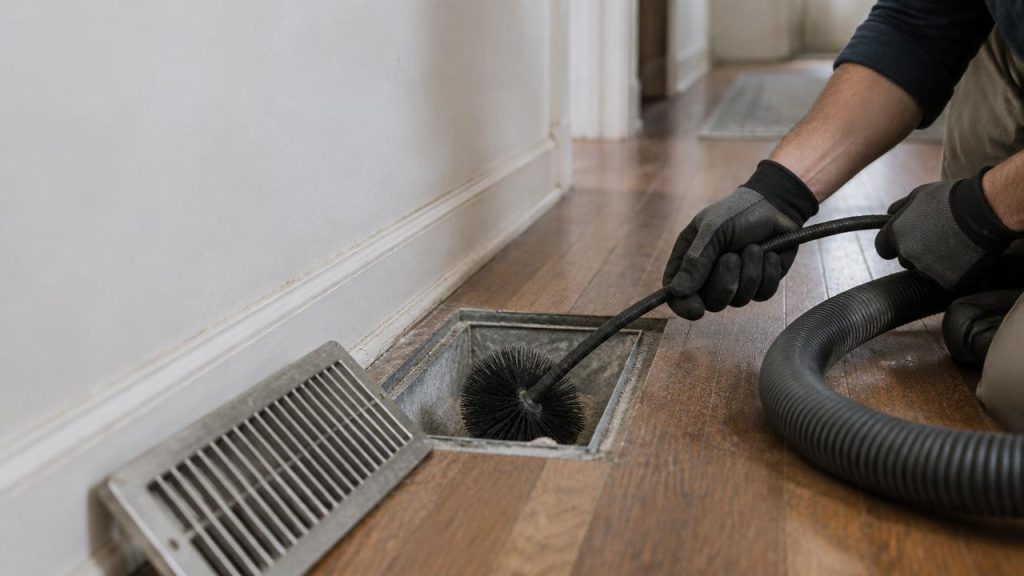
Is duct cleaning a waste of money? It is when you book it out of habit on a fixed schedule, but it earns its keep when your home gives you a real reason, such as visible mold, pest debris, heavy dust buildup, or a household with allergies or a baby. Energy savings are usually a shakier argument than indoor air quality, so the case rests mostly on dust and allergens rather than on your electric bill. A tidy system with no warning signs rarely needs attention, and a DIY pass only goes so far. So the decision comes down to weighing the air duct cleaning cost against what’s actually going on in your ducts and who is breathing the air.
Is Duct Cleaning a Waste of Money? The Short Answer
Duct cleaning is a smart investment when specific conditions in your home trigger it, but it’s a waste of cash if you’re only doing it because a postcard showed up in the mail.
- Cleaning pays off when you have visible mold growth inside ductwork or on HVAC components.
- It’s worth the cost after home renovations that generate significant drywall or sawdust debris.
- Households with allergy sufferers, infants, or immunocompromised residents see real indoor air quality benefits.
- Vermin infestations or pest debris inside ducts create an immediate health and sanitation need.
- You can skip it if your system is well-filtered, shows no dust symptoms, and has no respiratory-vulnerable occupants.
The average homeowner often operates on a “set it and forget it” mentality, assuming that because the HVAC company suggests annual service, ducts must need annual scrubbing. That logic creates wasted money fast. The Environmental Protection Agency recommends cleaning only when contamination is visible or when there’s a specific health concern, not on a calendar schedule. Blindly hiring a crew every spring doesn’t improve your home it improves the contractor’s bottom line. You need a specific trigger to make it worthwhile.
When Duct Cleaning Pays Off (and When You Can Skip It)
Value depends on your home’s condition and your household’s health needs, not on a calendar alone. Think of your ductwork as the lungs of your house. If they’re sucking in dust, mold spores, or critter waste, that contamination circulates through your living space. The air duct cleaning cost only hurts when you pay for a service your home doesn’t actually need. On the other hand, waiting too long when warning signs are present can degrade your HVAC efficiency and impact your family’s health.
- Pay for Cleaning: Visible mold growth on supply registers, vent covers, or inside the ducts themselves.
- Pay for Cleaning: Vermin activity droppings, nesting materials, or insect shells inside air ducts.
- Pay for Cleaning: Heavy dust accumulation around vent openings that returns within days of wiping.
- Pay for Cleaning: Recent renovation work that created fine particle debris, especially drywall dust.
- Skip or Wait: Your HVAC system is new, well-sealed, and uses high-quality filtration.
- Skip or Wait: No one in the home suffers from respiratory issues, allergies, or asthma symptoms.
The strongest case for cleaning usually comes after a specific event. A mold remediation project, for instance, is incomplete if the spores have traveled through the ducts. New constructions almost always trap construction dust inside the ductwork before the walls go up, meaning your “new” house might be cycling through drywall powder every time the AC kicks on. If you’re unsure about your specific situation, understanding why regular duct cleaning matters for your home can help clarify the decision. The presence of dust symptoms combined with a vulnerable household almost always justifies the expense.
Conversely, a pristine system doesn’t need help. If you’re already using a high-MERV filter, changing it regularly, and you don’t have pets shedding fur into the return, your ducts likely look cleaner than the day they were installed. In that scenario, duct cleaning benefits are negligible, and the money is better spent on better filters or system maintenance.
Can Clean Ducts Really Lower Your Energy Bills?
Debris-clogged ducts hinder airflow and make the HVAC system work harder than necessary. When the passages that carry conditioned air become restricted, your unit runs longer cycles to reach the temperature on your thermostat. This extra runtime shows up on your utility bill, but the connection isn’t always as dramatic as some service flyers might claim. The real energy culprit is often leaks rather than simple dust buildup.
Duct cleaning combined with sealing leaks can help conditioned air reach rooms instead of escaping into attics or crawl spaces. When air loss occurs in unconditioned spaces, your system is essentially cooling the attic. That wastes energy. While removing dust helps airflow, sealing those gaps is what moves the needle on energy consumption. A proper cleaning service often inspects for these leaks, and addressing them is where the genuine efficiency gains hide.
According to the U.S. Department of Energy, 25 to 40 percent of the energy used for heating or cooling a home is wasted because ducts are not sealed or insulated properly, leading to significant energy loss.
Clean ducts allow air to move freely, but they don’t do much for efficiency if that air never makes it to your living room. The argument for lower bills relies on a combination of cleaning and repair. If your primary motivation is financial, read more on how duct cleaning can help reduce energy bills to understand the full picture. It’s rarely a standalone solution for high bills, but it can be part of a larger efficiency strategy.
Allergies, Babies and Indoor Air: Where the Real Value Lies
Dust, pet dander and mold spores circulate through ducts and can aggravate respiratory problems. For many Austin families, the air duct cleaning cost is justified not by what they save on bills, but by what they gain in peace of mind. The indoor air quality inside a home can sometimes be worse than the air outside, especially during Central Texas allergy seasons when cedar, oak, and ragweed counts spike. Your ductwork acts as a collection point for these irritants.
Families with allergy sufferers or infants in hot, dusty Central Texas often see the strongest case for cleaning. Babies have developing respiratory systems, and exposure to high levels of dust and allergens can trigger early sensitivities. When a household includes someone who already struggles with asthma or seasonal allergies, cleaning the ducts removes a reservoir of triggers that would otherwise circulate every night while they sleep.
- Dust Mites and Debris: Accumulated dust provides a habitat for mites, which circulate when the system engages.
- Pet Dander: Microscopic skin particles from dogs and cats collect in return ducts and redistribute throughout the home.
- Mold Spores: Moisture issues inside ductwork can lead to spore colonies that trigger allergic reactions.
- Pollen Intrusion: Outdoor allergens entering through returns settle in ductwork and get resuspended during HVAC cycles.
Removing these contaminants does not guarantee a cure for allergies, but it reduces the overall load on the immune system. For parents bringing home a newborn, the desire to start with a clean slate is a powerful motivator. If you want to explore this angle further, you can check out duct cleaning for allergies and respiratory issues to see how targeted cleaning can help vulnerable household members breathe easier.
The EPA notes that indoor air can be two to five times more polluted than outdoor air, and dust and allergens trapped in ductwork contribute significantly to this pollution when systems are not properly maintained.
Professional vs. DIY Cleaning: Where Your Money Is Best Spent
Professional cleaning reaches the whole duct system, while DIY efforts typically only cover vents and registers. The biggest argument for hiring a pro is equipment power. Consumer-grade vacuums and shop vacs simply do not have the suction or agitation tools necessary to dislodge debris stuck to duct walls. When homeowners attempt a deep clean themselves, they often end up pushing dust further into the system rather than removing it.
Wasted money usually comes from rushed, low-quality jobs, so checking a provider’s process matters more than price. A cut-rate service might blow air into the ducts and call it a day, stirring up dust that settles right back down. A thorough job involves using truck-powered vacuums, HEPA filtration, and agitation devices like brushes or air whips that scrub the interior surfaces without damaging the ductwork. The difference in results is substantial.
| Factor | DIY Cleaning | Professional Cleaning |
|---|---|---|
| Reach | Limited to vents and accessible return openings | Access to main trunk lines and entire system length |
| Equipment | Shop vacs, manual brushes, household tools | Truck-mounted vacuums, HEPA systems, rotary brushes |
| Thoroughness | Surface-level cleaning only; may disturb settled dust | Deep cleaning that removes adhered debris and contaminants |
| Risk | Potential to damage flex duct or push debris deeper | Insured work and techniques that prevent duct damage |
- Ask if they use negative air pressure equipment to capture dust before it circulates in the home.
- Ask whether the service includes cleaning the evaporator coil and blower motor, not just the ducts.
- Ask if they perform a visual inspection before and after, ideally with an inspection camera.
- Ask if they use HEPA filtration to ensure dust doesn’t exhaust back into your living space.
Understanding the differences in DIY vs. professional duct cleaning can save you from a frustrating experience. If you are going to spend the money, you want the service to count. DIY cleaning has its place for quick vent wipes, but for a true deep clean, the professional equipment gap is too large to bridge.
Duct Cleaning FAQs for Austin-Area Homeowners
How often should Austin homeowners have their ducts cleaned if they have pets?
No fixed schedule is required. | Pet dander accumulates faster than standard household dust, so HVAC efficiency can suffer sooner. | Most homes with shedding pets benefit from an inspection every two to three years, but cleaning is only necessary if debris is visible.
Can duct cleaning make allergies worse right after the service?
Yes, temporarily. | The cleaning process stirs up dust and particles that have settled inside the ductwork. | Professional technicians use negative air pressure to capture this debris, but sensitive individuals should leave the home during the service and return only once the air has settled.
Is duct cleaning worthwhile in a newly built or recently renovated home?
Yes, highly recommended. | Construction projects leave behind drywall dust, sawdust, and insulation fibers that settle in ducts before grilles are installed. | Removing this dust and allergens before you move in prevents construction debris from circulating through your living space for years.
Does duct cleaning help if I already change my air filter regularly?
It can, but it’s less likely to be needed. | High-quality filters capture a large percentage of particulates before they enter the ductwork system. | If your filter is doing its job and you have no respiratory issues in the home, the dust and allergens accumulating in your ducts will be minimal, reducing the need for professional intervention.
What should I do if I find mold in my vents?
Do not attempt to clean it yourself. | Disturbing mold colonies can release spores into your home’s air supply. | Contact a professional air duct cleaning service that specializes in mold remediation to assess the source and safely remove the contamination.
Are air duct cleaning deals that sound too cheap a red flag?
Yes, they often signal a bait-and-switch operation. | Reputable truck-mounted vacuum service requires significant labor and equipment costs. | Extremely low advertised prices usually only cover a few vents and result in aggressive upselling for “additional” services that should have been included in a proper cleaning.