
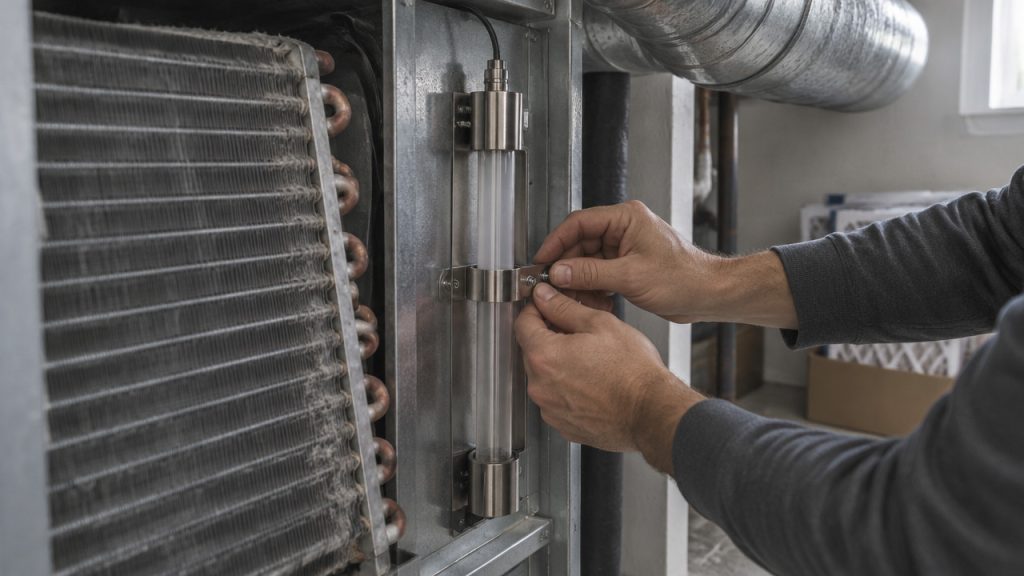
UV light disinfection uses germicidal UV-C light to disrupt the DNA of bacteria, viruses and mold spores as air passes through your HVAC system, so they can’t keep multiplying. It works best on the damp evaporator coil and air handler, where microbes like to settle. It doesn’t pull dust, pollen or debris out of the air, which is why it complements duct cleaning and good filters rather than replacing them. For an Austin home with allergy sufferers or a new baby, the decision comes down to whether your system needs cleaning first, a UV light installed, or both.
What Is UV Light Disinfection, and Does It Work in a Home HVAC System?
UV light disinfection is a proven method for neutralizing biological contaminants inside your HVAC system, transforming your air handler into a cleaner environment for your whole house.
- UV-C rays penetrate and break down the DNA of mold, bacteria and viruses.
- Installation targets the evaporator coil and air handler where moisture invites growth.
- The light works continuously as your system runs, treating air in real time.
- It is not a filter and cannot remove dust, pet dander or physical debris.
- Professional assessment ensures the light has proper intensity and placement.
This technology has roots in hospitals and laboratories, where maintaining sterile environments is critical. Now scaled for residential use, it brings that same level of microbial control into your living space. The core principle is simple but effective: the light creates a hostile environment for microorganisms right at the source. Instead of trying to chase down germs after they circulate, you stop them where they grow.
How UV-C Light Neutralizes Germs Inside Your Air Handler
Your air handler is the heart of your home’s comfort system, and it is also the perfect breeding ground for microbes. The combination of darkness and moisture inside the unit creates ideal conditions for mold and bacteria to establish colonies. UV-C light targets this weakness with precision. The wavelengths used in HVAC UV light systems are specifically selected for their germicidal properties. These rays are shorter and more energetic than visible light, giving them the power to physically alter the structure of microorganisms. When the light hits a pathogen’s DNA, it causes damage that prevents the organism from replicating. A microbe that cannot reproduce cannot spread or cause illness, essentially rendering it harmless.
This process happens continuously inside your system. Every time air passes over the coil or through the illuminated section of ductwork, any microbes floating in that air get exposed to the light. For why disinfection matters for indoor air quality, this constant exposure adds a layer of protection that air filters simply cannot match. The light sits inside the system, working silently in the background to keep the coil and surrounding areas cleaner than they would be otherwise. The evaporator coil, where condensation forms as your AC runs, is particularly vulnerable to mold growth. A properly positioned UV light keeps this surface cleaner, which supports system efficiency as a bonus to the air quality benefits.
- Bacteria: The light penetrates bacterial cell walls and disrupts reproductive capability.
- Viruses: UV-C rays damage viral RNA or DNA, neutralizing airborne viruses.
- Mold Spores: The light prevents mold from establishing colonies on damp surfaces.
- Other Airborne Pathogens: Any microorganism with DNA remains vulnerable to UV exposure.
The light only affects what passes through its beam or what sits on surfaces within range. It cannot penetrate walls or ductwork to treat areas it cannot see, which is why placement matters so much. A professional installer positions the fixture to maximize exposure in the areas most likely to harbor growth.
What You Actually Get: Benefits for Allergies, Babies and Your HVAC
Families in Austin have specific reasons for considering UV technology. The local climate, with its high humidity and long cooling season, puts extra stress on HVAC systems. A system running almost constantly for months at a time has more opportunities to develop moisture issues. For allergen reduction, UV light offers a passive way to address biological triggers that float through your home. It does not replace your filter, and it does not remove pollen or dust. What it does is address the living contaminants mold spores, bacteria and other microbes that can make allergy symptoms worse or cause their own set of respiratory issues. For families with babies, the indoor air quality conversation takes on added weight. Infants have developing respiratory systems that are more sensitive to indoor air pollution.
Beyond health considerations, there is a practical benefit for your equipment. A cleaner evaporator coil transfers heat more efficiently than one coated in biofilm. When mold and bacteria grow on the coil, they create an insulating layer that forces your system to work harder to cool your home. The UV light keeps that surface cleaner, which can translate to lower energy use and reduced wear on components. This is not a magic cure-all, but it is a step toward better system health. Cleaner coils also mean less frequent deep cleaning, which saves money on maintenance over time.
- Fewer airborne mold spores: The light reduces mold at its source inside the air handler.
- Reduced bacteria and viruses: Continuous exposure neutralizes microbes in treated areas.
- Help for allergy sufferers: Biological contaminants that trigger symptoms get treated.
- Healthier environment for babies: Infants breathe air with fewer active germs circulating.
- Cleaner HVAC components: The coil stays cleaner, supporting efficiency and longevity.
Think of UV light as one part of a broader strategy. It pairs with good filtration, regular maintenance and humidity control to create a comprehensive approach to difference between duct cleaning and cleaning with disinfection in your home.
UV Light vs. Duct Cleaning and Chemical Disinfection: Which Does What?
Homeowners often wonder if UV light can replace duct cleaning or chemical treatments. The answer is that they serve different functions. None of these solutions is a complete substitute for the others. Understanding the difference helps you decide what your home needs now and what you might add later. Duct cleaning physically removes accumulated debris from your ductwork. It is a deep-clean service that addresses years of dust, pet hair, construction debris and other particulates that have settled in your system. It resets the ductwork to a cleaner state, but it does not prevent future biological growth on its own. Chemical disinfection treats the surfaces inside your ductwork and air handler with agents designed to kill mold and bacteria. It is often applied as part of a cleaning service to address active contamination.
UV light, by contrast, provides continuous treatment rather than a one-time cleaning. It is effective against microorganisms but cannot remove physical debris. If your ducts are already full of dust, adding a UV light will not make that dust disappear. It works best as a preventative measure or as a way to address ongoing biological issues after cleaning has removed the bulk of the contamination. The table below breaks down how each solution fits into a home maintenance plan.
| Solution | Purpose | How It Works | When It Fits |
|---|---|---|---|
| UV-C Light | Prevent and reduce microbial growth | Continuous light exposure disrupts organism DNA | Ongoing protection after cleaning; homes with allergy or health concerns |
| Duct Cleaning | Remove built-up dust and debris | High-powered vacuum and brushing tools | Visible debris in ducts; after renovation; every 3-5 years for maintenance |
| Disinfectant Treatment | Kill active mold and bacteria | EPA-registered antimicrobial agents applied to surfaces | Active mold growth; musty odors; after water damage or infestation |
The right choice depends on what you are seeing, smelling or experiencing in your home. A musty odor suggests active mold, which may need cleaning and disinfection before UV light makes sense. Visible dust around your vents points to debris buildup that physical cleaning addresses. For families concerned about long-term air quality, the combination of all three services provides the most comprehensive result.
What Professional UV Light Installation Looks Like in Austin Homes
Installing a UV light inside your HVAC system is not a DIY project. The equipment requires proper positioning, secure mounting and safe electrical connections. A professional installer knows how to integrate the light without compromising your system’s warranty or safety. For HVAC disinfection in Austin, the process typically follows a structured approach.
- Assessment and planning: A technician evaluates your HVAC system, looking at the layout of the air handler, access points and the condition of the coil. They determine the optimal location for the light usually near the evaporator coil or inside the return air plenum and select a fixture with the right intensity for your system’s size and airflow.
- Professional placement: The installer mounts the UV fixture securely, ensuring the light will illuminate the target surface effectively. They position it to maximize exposure while keeping the unit accessible for future bulb changes. Wiring is connected safely, often using existing access points in the system’s electrical compartment.
- System integration and safety check: After installation, the technician tests the system. They verify the light operates correctly, check that the HVAC system functions normally with the new addition and review safety features like automatic shutoff if the unit is opened. They also explain maintenance requirements, including how often to change the bulb.
The entire process usually takes a few hours. Once installed, the UV light runs automatically whenever your system operates. There are no buttons to push or settings to adjust. The only ongoing maintenance is a bulb change on a schedule typically every one to two years depending on the specific product. The bulbs lose effectiveness over time even if they still glow, so following a replacement schedule matters.
UV Light Disinfection FAQs
Is UV light in an HVAC system safe for babies and pets?
Yes. The UV-C light is fully contained inside your HVAC system, with no direct exposure to living spaces. The light treats air and surfaces within the air handler, while your family remains in a separate, safe environment. The result is air that has passed through a germicidal treatment zone, not air that carries any radiation risk. For homes with infants or pets, this offers peace of mind alongside the air quality benefits.
Will UV light replace my air filter or duct cleaning?
No. UV light targets biological contaminants like mold and bacteria, but it cannot capture dust, pollen or pet dander. Your air filter still handles particulate matter, and duct cleaning still removes built-up debris. Think of UV as a complement to your existing maintenance, not a substitute. The three approaches work together to address different types of indoor air pollution. For guidance on timing, see how often to schedule duct cleaning and disinfection.
Can UV light help with mold growing on my AC coils?
Yes. The evaporator coil is one of the most common placement points for UV lights precisely because it is so prone to mold growth. The cool, damp surface attracts microbes, and the light shines directly on that surface to disrupt their lifecycle. Existing mold may need to be cleaned first, but the light prevents regrowth after treatment. This keeps your coil cleaner and supports better system efficiency over time.
How often should I schedule duct cleaning if I have UV light installed?
Every 3 to 5 years is typical for most homes. UV light does not change the rate at which dust and debris accumulate in your ductwork. It keeps the coil and immediate area cleaner biologically, but dust still settles throughout the system over time. Regular duct cleaning removes that accumulation. Homes with pets, allergies or recent renovations might benefit from more frequent cleaning regardless of UV installation.
Can UV light lower my energy costs?
It can help indirectly. A cleaner evaporator coil transfers heat more efficiently, which means your system may use less energy to achieve the same cooling effect. UV light keeps biofilm from building up on the coil, preserving that efficiency. The savings are modest compared to other factors like thermostat settings and insulation, but the benefit is real. The bigger financial benefit comes from reduced cleaning and maintenance needs over the life of your system.
What disinfectants are used alongside UV treatment?
Professional-grade antimicrobials. If active mold or heavy contamination is present, technicians apply EPA-registered disinfectants to the coil, drain pan and duct surfaces before or alongside UV installation. These products kill existing growth so the light can maintain a cleaner environment going forward. The specific product varies by situation, but all are selected for safety and effectiveness in HVAC applications. The goal is to address the current problem and prevent future issues.