
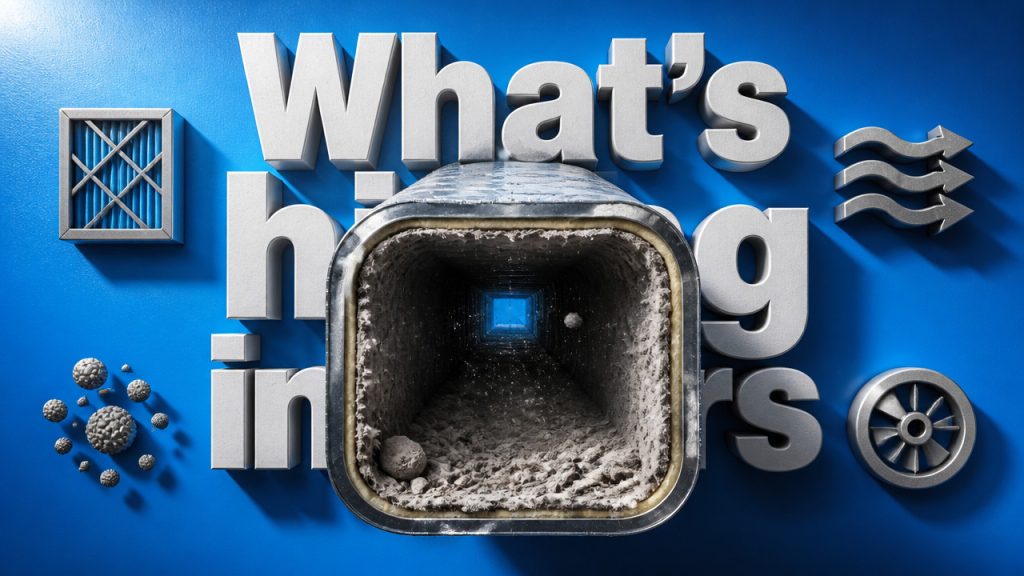
Cleaning out air ducts requires professional-grade equipment, NADCA-certified techniques, and a systematic approach that removes accumulated debris, allergens, and contaminants from your HVAC system. Austin homeowners face unique challenges with cedar pollen, limestone dust, and Central Texas humidity that accelerate duct contamination making proper cleaning essential for maintaining indoor air quality, reducing allergy symptoms, and protecting your family’s respiratory health year-round.
The 30-Second Answer: What Cleaning Out Air Ducts Actually Involves
When you clean out air ducts professionally, you’re not just vacuuming out visible dust. The process involves a comprehensive ventilation system cleaning that addresses the entire HVAC system the supply ducts, return ducts, registers, grilles, and the air handler unit itself. Think of it as a deep tissue massage for your home’s respiratory system.
DIY attempts with shop vacs and flexible brushes barely scratch the surface. The reality is that residential duct cleaning requires specialized equipment capable of creating negative air pressure that pulls debris from deep inside the ductwork. Without this suction power, you’re essentially moving dust around rather than removing it.
Central Texas adds another layer of complexity. The duct contamination removal process here must account for our notorious cedar pollen outbreaks, fine limestone dust that permeates everything, and humidity levels that turn ductwork into potential mold incubators. Austin homes accumulate debris 2-3 times faster than homes in drier climates.
- Inspection with high-resolution cameras to assess contamination levels
- Creation of negative air pressure using truck-mounted vacuum systems
- Mechanical agitation with brushes and air whips to dislodge stuck debris
- HEPA-filtered extraction removing particles as small as 0.3 microns
For homeowners considering professional air duct cleaning services, understanding this process helps separate legitimate operations from blow-and-go scams that charge premium prices for superficial work.
Why Austin’s Climate Makes Regular Duct Cleaning Non-Negotiable [2026 Study]
Austin homeowners face a perfect storm of airborne contaminants that make HVAC duct cleaning far more critical here than in many other parts of the country. The annual cedar fever season dumps millions of pollen particles into the air, and your HVAC system pulls every bit of it through your ductwork. Those particles don’t just disappear they accumulate in the bends and junctions of your ductwork maintenance system.
The limestone bedrock that defines Central Texas geology creates a fine, powdery dust that infiltrates homes constantly. Unlike coarse sand, these particles are fine enough to pass through standard filters and settle inside ductwork. Over time, this mineral dust combines with organic debris to create a concrete-like accumulation that standard vacuuming cannot remove.
Humidity presents the third challenge. Austin’s average relative humidity hovers between 60-70% for much of the year, creating ideal conditions for mold growth inside ductwork where condensation occurs. When cold air passes through ducts in conditioned spaces, temperature differentials cause moisture to accumulate moisture that feeds mold colonies in your air duct debris removal challenges.
| Season | Primary Contaminant | Contamination Level | Cleanout Urgency |
|---|---|---|---|
| Winter (Dec-Feb) | Cedar Pollen | Severe | Critical – Pre-season |
| Spring (Mar-May) | Oak/Grass Pollen | High | High |
| Summer (Jun-Aug) | Limestone Dust | Moderate-High | Moderate |
| Fall (Sep-Nov) | Ragweed/Mold Spores | Moderate | High (post-humid) |
Cedar pollen counts in Central Texas can reach 10,000+ grains per cubic meter during peak season, with particles small enough to bypass standard HVAC filters and accumulate deep in residential ductwork. Source: American Academy of Allergy, Asthma & Immunology.
Understanding the health benefits of cleaned air ducts becomes particularly urgent for families with babies, elderly members, or anyone managing respiratory conditions.
The Complete 7-Step Process Professionals Use to Clean Out Air Ducts
Professional air duct sanitization follows a systematic methodology developed by the National Air Duct Cleaners Association. This isn’t a casual vacuuming job it’s a structured process designed to remove contamination without releasing particles back into your living space.
The process begins before any cleaning equipment turns on. Technicians conduct a thorough inspection using insertion cameras that snake through the ductwork, documenting contamination levels and identifying problem areas like disconnected sections, water damage, or pest infiltration. This assessment determines the appropriate air duct purification approach.
- Visual inspection with camera documentation of pre-cleaning conditions
- Creation of access points in the plenum and main trunk lines
- Connection of truck-mounted vacuum creating negative air pressure
- Sealing of all supply and return registers to maximize suction
- Mechanical agitation using brushes, air whips, and skipper balls
- HEPA-filtered extraction of all dislodged debris
- Application of antimicrobial treatment (when mold is present)
The negative air pressure system is the workhorse of professional cleaning. By creating suction stronger than your home’s HVAC blower can produce, technicians ensure that loosened debris travels outward toward the vacuum rather than inward toward your living spaces. This negative pressure containment means duct contamination removal happens without filling your home with the dust being extracted.
Post-cleaning sanitization represents the final step when biological contamination is present. EPA-registered antimicrobial agents are fogged through the system, coating interior surfaces and inhibiting future mold growth. This deep cleaning techniques for air ducts approach ensures the system returns to clean, sanitary condition.
Step-by-Step: The Source Removal Method Explained
The NADCA Standard defines source removal as the only acceptable method for cleaning HVAC systems. This means physically removing contaminants from the ductwork rather than simply treating them with chemicals or attempting to encapsulate them. Effective effective duct cleaning methods prioritize removal over treatment.
Mechanical agitation tools are essential for breaking loose debris that has adhered to duct walls over years of accumulation. Rotary brushes spin at high RPM, scrubbing the interior surfaces. Air whips use compressed air to create turbulence that dislodges stuck particles. For flex duct, softer brushes prevent damage while still providing adequate agitation.
HEPA filtration during extraction captures particles as small as 0.3 microns with 99.97% efficiency. This matters because many allergens pollen, mold spores, pet dander fall into this size range. Without HEPA filtration, the vacuum exhaust would simply blow these contaminants back into your home, defeating the purpose of cleaning.
Equipment That Actually Works: What Separates Amateur from Professional Cleaning
The difference between professional HVAC duct cleaning and amateur attempts comes down to equipment capability. A shop vac produces around 150 CFM of suction. A truck-mounted vacuum system produces 10,000+ CFM that’s roughly 67 times more power. This difference isn’t incremental; it’s transformational.
Portable vacuum units used by some companies fall somewhere in between, typically producing 2,000-3,000 CFM. While adequate for maintenance cleaning of lightly contaminated systems, they struggle with the heavy accumulation common in Austin homes. The investment in finding qualified air duct cleaning professionals pays off because proper equipment actually removes contamination rather than redistributing it.
| Equipment Type | CFM Rating | Typical Application | Austin Home Suitability |
|---|---|---|---|
| Shop Vac (DIY) | 100-150 | Spot cleaning registers | Insufficient |
| Portable Vacuum | 2,000-3,000 | Light maintenance | Marginal |
| Truck-Mounted Vacuum | 10,000-15,000 | Full system cleaning | Recommended |
| HEPA Vacuum Collection | 2,500+ | Final debris capture | Required for IAQ |
Inspection cameras matter just as much as cleaning equipment. Professional-grade cameras offer resolution high enough to distinguish between dust accumulation, mold growth, and construction debris. This matters because treatment protocols differ significantly depending on what’s actually in the ductwork.
Red Flags Austin Homeowners Miss That Signal It’s Time to Clean
Most homeowners wait until visible problems appear before considering ventilation system cleaning. But by the time contamination becomes obvious, your family has been breathing degraded air for months or years. Recognizing early warning signs protects your health and prevents more extensive remediation later.
Visible mold around supply register vents represents an advanced problem. The mold you see is just the tip of the contamination spores have already colonized deeper into the ductwork maintenance system where moisture accumulates. Black or greenish discoloration around vent edges warrants immediate professional assessment.
- Visible mold growth around supply register vents
- Excessive dust coating furniture within days of cleaning
- Musty or stale odor when HVAC cycles on
- Unexplained allergy symptoms that worsen at home
- Dust trails visible around vent edges
- Recent home renovation or construction project
Excessive dust accumulation around vents, particularly shortly after changing filters, indicates bypass contamination. Your filter should capture most particles; if dust is cycling through, the system has developed gaps or the ductwork is so saturated that normal airflow picks up debris. Recognizing signs your air ducts need immediate cleaning helps Austin homeowners act before small problems become health hazards.
Pet owners face accelerated contamination. Dander and hair particles bypass standard filters, accumulating in return ducts where airflow velocity drops. Over time, this organic material provides food for dust mites and, in humid conditions, mold colonies.
Cost Breakdown: What You’re Actually Paying For When You Clean Out Air Ducts
Austin metro area residential duct cleaning pricing varies significantly based on home size, system complexity, and contamination level. Understanding pricing models helps you identify fair quotes versus pricing designed to upsell unnecessary services. The old adage applies: if a price seems too good to be true, the service probably is.
Whole-system pricing typically runs more transparent than per-vent quotes. A per-vent price of $35 sounds reasonable until you realize your Austin home has 15 supply vents, 4 returns, and a main trunk line and the quote doesn’t include sanitization, access panel creation, or blower cleaning. improving air quality through professional cleaning requires understanding what comprehensive service includes.
| Service Tier | Typical Austin Pricing | What’s Included |
|---|---|---|
| Basic Clean | $300-$500 | Supply/return ducts, standard access |
| Comprehensive | $500-$800 | Full system, blower, coils, sanitization |
| Deep Restoration | $800-$1,200+ | All above plus mold remediation, UV treatment |
Certain upsells provide genuine value. Mold remediation treatments when biological contamination exists worth every penny. UV light installation for ongoing antimicrobial protection legitimate technology. Electrostatic air cleaner upgrades demonstrable filtration improvement. Skip the “odor elimination” sprays and “sealant” applications that mask problems rather than solving them.
Key Takeaways: Your Austin Air Duct Cleaning Action Plan
Austin’s unique combination of heavy pollen loads, limestone dust, and humidity makes air duct debris removal more urgent here than in most markets. Understanding when to clean, what to expect, and how to evaluate service providers protects both your family’s health and your HVAC investment.
- Clean air ducts every 3-5 years minimum for Austin homes every 2-3 years for allergy sufferers
- NADCA certification separates professionals from amateurs always verify credentials
- Schedule cleaning in fall before cedar season or spring after oak pollen subsides
- Truck-mounted equipment outperforms portable units by orders of magnitude
- Visible mold or excessive dust warrants immediate professional assessment
The timing matters. Scheduling recognizing when ducts require cleaning before Austin’s cedar fever season means your family breathes clean air when pollen counts hit their peak. Fall cleaning October and November prepares your system for the winter months when homes stay sealed tight and indoor air quality suffers most.
FAQ: Cleaning Out Air Ducts in Austin Homes
How often should I clean out air ducts in my Austin home?
Every 3-5 years for typical homes, more frequently for allergy sufferers or homes with pets. The National Air Duct Cleaners Association recommends assessment annually and cleaning as needed based on contamination levels. Austin’s environment pushes many homes toward the lower end of that recommendation.
How long does professional air duct cleaning take?
3-5 hours for an average-sized Austin home with one HVAC system. Larger homes with multiple systems or extensive contamination may require a full day. Rush jobs often mean corner-cutting, so be wary of companies promising completion in under two hours.
Does cleaning out air ducts really improve allergy symptoms?
Yes, measurably for many Austin residents. Clinical studies show reduced airborne particulate concentrations of 40-60% after professional cleaning. For cedar fever sufferers specifically, removing accumulated pollen from ductwork limits ongoing exposure during peak season.
Can I clean my own air ducts with a shop vac?
No, not effectively. Shop vacs produce insufficient suction to remove deep accumulation. You may clear visible debris near registers, but contamination 10+ feet into the ductwork remains untouched. DIY attempts often make the problem worse by loosening debris without capturing it.
What’s the difference between air duct cleaning and mold remediation?
Scope and protocol distinguish these services. Standard cleaning removes debris; mold remediation addresses biological contamination with antimicrobial treatment, containment procedures, and verification testing. If mold is visible, basic cleaning addresses symptoms without solving the underlying problem.
Will cleaning my air ducts reduce my energy bills?
Potentially 5-15% when heavy contamination restricts airflow. Dirty blower wheels and clogged evaporator coils force your system to run longer cycles. However, energy savings alone rarely justify cleaning costs the primary benefit is indoor air quality improvement.
Should I be home during the duct cleaning process?
Not necessary, though many homeowners prefer being present for the post-cleaning walkthrough. Technicians need exterior access for truck-mounted equipment and interior access to all registers. Most companies allow homeowners to leave during the 3-5 hour process.