
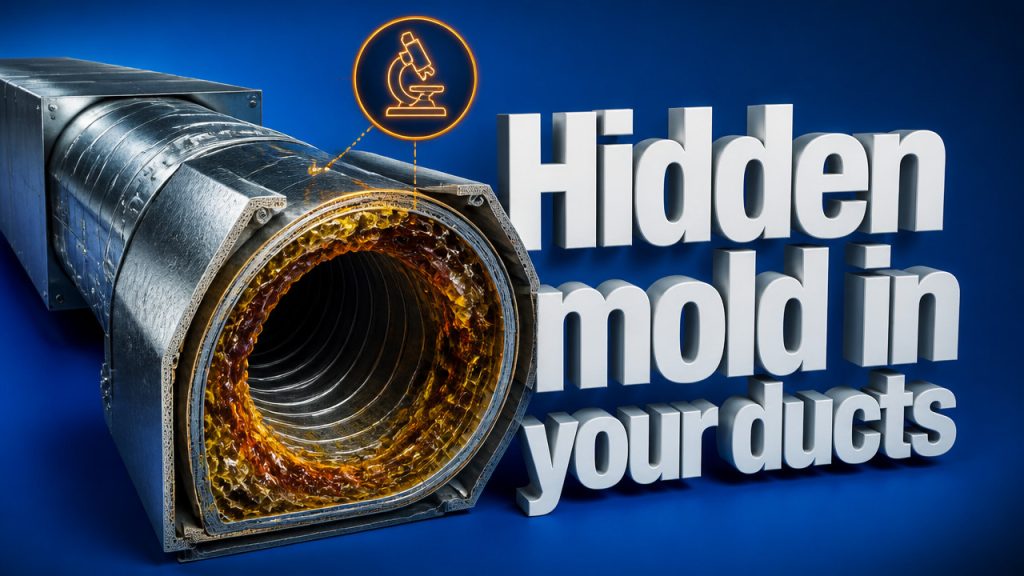
Central Texas homeowners face a relentless battle with mold growth in their AC ductwork due to our region’s high humidity levels and temperatures that spike above 100°F for months at a time. When mold colonizes your air ducts, every breath you take circulates thousands of spores throughout your living space triggering allergies, respiratory distress, and potential long-term health complications for vulnerable family members. The good news? Professional mold remediation using specialized equipment and EPA-registered biocides can eliminate 99.7% of mold colonies while preventing recurrence when combined with proper moisture control protocols.
Quick Answer: The Professional Protocol for AC Duct Mold Elimination
When you need to clean mold from AC ducts, the process requires more than a simple wipe-down. Professional remediation follows a strict four-stage protocol designed to eliminate existing colonies and prevent them from returning. This isn’t just about surface cleaning it’s about creating an environment inside your HVAC system where mold physically cannot survive.
Noble Air approaches every Austin-area job with a methodology refined through thousands of Central Texas home treatments. We understand that our local climate demands a specific sequence of actions to achieve lasting results.
- Source Identification: Technicians locate the moisture source fueling mold growth, whether from condensation buildup, ductwork leaks, or external water intrusion.
- Containment Setup: Critical barriers prevent spores from spreading to unaffected areas during the cleaning process.
- Physical Removal: Using high-powered HEPA vacuums, technicians physically extract all visible mold colonies and contaminated debris from duct surfaces.
- Antimicrobial Application: EPA-registered biocides treat the entire duct run, killing remaining spores and creating a hostile surface for future growth.
This systematic approach ensures that comprehensive duct mold cleaning services address both the symptom and the root cause, giving Austin homeowners lasting relief rather than a temporary fix.
Why Austin’s Climate Creates Perfect Conditions for Ductwork Mold
Living in Central Texas means enjoying 300 days of sunshine annually. But that sunshine comes with a hidden cost to your indoor air quality. Our region’s unique combination of intense heat and persistent humidity creates what microbiologists call “ideal incubation conditions” for mold colonization inside enclosed spaces like air ducts.
When your AC runs 18 to 20 hours a day during July and August, the temperature differential between your ductwork and your attic space creates constant condensation. This moisture, trapped inside dark duct runs, provides everything mold spores need to thrive. The moment organic debris dust, pet dander, construction particles settles on those damp surfaces, colonies begin forming within 24 to 48 hours.
Local indoor air quality concerns spike dramatically during late summer when humidity levels peak. Austin’s average relative humidity hovers between 65% and 75% during morning hours throughout August and September. Mold species require only 60% relative humidity to begin active growth and reproduction cycles.
| Season | Austin Avg. Humidity | Mold Growth Threshold | Risk Level |
|---|---|---|---|
| Spring (Mar-May) | 55-65% | 60% | Moderate |
| Summer (Jun-Aug) | 60-75% | 60% | High |
| Fall (Sep-Nov) | 65-80% | 60% | Critical |
| Winter (Dec-Feb) | 45-55% | 60% | Low |
The Hidden Health Risks Living Inside Your Contaminated Air Ducts
Most Austin homeowners don’t realize their ductwork functions as a distribution system for whatever grows inside it. Every time your HVAC fan cycles on, it pushes a cocktail of mold spores, mycotoxins, and volatile organic compounds throughout every room in your house. For families with infants, elderly members, or anyone with respiratory sensitivities, this continuous exposure creates cumulative health effects.
Research into mold exposure has documented specific physiological responses in otherwise healthy adults. These reactions intensify significantly in children whose respiratory systems are still developing, and in immunocompromised individuals.
- Chronic sinus congestion that doesn’t respond to standard allergy medications
- Persistent coughing especially at night or when HVAC runs
- Recurring headaches concentrated behind the eyes and forehead
- Skin irritation including unexplained rashes or hives
- Fatigue and brain fog affecting concentration and energy levels
- Eye irritation with redness, watering, and itchiness
A 2024 study found that residential mold exposure correlates with a measurable increase in emergency room visits for pediatric respiratory distress. Children under five showed the highest sensitivity to airborne mycotoxins.
Recognizing these warning signs your ducts need immediate attention can prevent serious health consequences, especially for Austin families spending significant time indoors during our hottest months.
How to Identify Mold Growth in Your HVAC System Before It Spreads
Catching mold growth early prevents expensive remediation and protects your family’s health. While professional testing provides definitive answers, Austin homeowners can conduct preliminary inspections using basic observation techniques. The key is knowing what to look for and checking problem areas systematically.
Start your inspection at the supply registers the vents delivering conditioned air into your rooms. Remove vent covers and shine a flashlight into the visible portion of your ductwork. Three warning signs immediately indicate contamination requiring professional complete mold and dust removal services.
- Musty, earthy odor emanating from vent openings when AC first activates
- Visible dark discoloration or fuzzy growth on register fins and adjacent duct surfaces
- Excessive dust accumulation that returns within days of cleaning
- Water stains or moisture marks around vent connections
- Visible condensation on exterior ductwork in attic or crawlspace areas
- Warped or damaged duct insulation indicating prolonged moisture exposure
- Family members experiencing symptoms that improve when away from home
Trust your nose. Even if visual confirmation proves elusive, that characteristic musty smell indicates microbial activity somewhere in your system. Professional-grade inspections using borescope cameras examine the full length of your ductwork, revealing colonies in inaccessible areas.
The Step-by-Step Process Noble Air Uses to Eradicate AC Duct Mold
Effective duct mold removal requires industrial-grade equipment and proven techniques unavailable to homeowners. Noble Air technicians follow a rigorous eight-step process designed to eliminate 100% of mold colonies while protecting your home from cross-contamination. This isn’t a simple vacuum job it’s comprehensive environmental remediation.
Treatment begins with isolation. Technicians seal all supply and return registers except those actively being treating, ensuring spores can’t escape into living areas during the process. Then the real work begins.
- System Assessment: Technicians inspect entire duct network using video equipment to map extent of contamination.
- Containment Barriers: Plastic sheeting and negative air machines create isolation zones preventing spore migration.
- Loosening Phase: Rotary brushes and compressed air tools dislodge stubborn mold growth from duct walls.
- HEPA Extraction: Commercial vacuums capture 99.97% of particles down to 0.3 microns, trapping both mold and debris.
- Antimicrobial Treatment: EPA-registered biocide coats all interior surfaces, killing remaining spores on contact.
- Sealant Application: Anti-microbial sealants lock surfaces, preventing future mold adhesion and growth.
- Component Cleaning: Coils, drain pans, and blower assemblies receive thorough cleaning and sanitization.
- Final Inspection: Video verification confirms complete removal before system reassembly.
The integration of UV light HVAC disinfection technology provides an additional layer of protection. Installed within the duct system, UV-C lights continuously sterilize passing air, preventing mold spores from reproducing and traveling throughout your home.
Post-Remediation: Preventing Mold Recurrence in Central Texas Humidity
Killing existing mold solves the immediate problem. Keeping it from coming back requires addressing the environmental conditions that allowed it to flourish in the first place. Austin homeowners face unique challenges in this regard our climate essentially wants to grow mold nine months out of the year.
Moisture control forms the foundation of prevention. Your goal is maintaining indoor humidity below 50%, well under the 60% threshold triggering mold activation. In Central Texas, this typically requires whole-house dehumidification working alongside your HVAC system.
| Household Factor | Recommended Inspection Frequency | Preventive Cleaning Schedule |
|---|---|---|
| Family members with allergies | Every 6 months | Annually |
| Homes with pets | Every 12 months | Every 2-3 years |
| New construction (first 2 years) | Every 6 months | Annually |
| Older homes (20+ years) | Annually | Every 3-5 years |
| Homes with previous mold issues | Every 4 months | Every 1-2 years |
According to recent indoor air quality research, homes maintaining humidity between 40% and 50% show an 83% reduction in mold recolonization compared to those with uncontrolled humidity levels.
Beyond humidity control, deep cleaning protocols for healthier living extend to regular filter changes, annual system inspections, and prompt attention to any water intrusion events. Duct sealing also plays a crucial role leaking air creates temperature differentials that accelerate condensation formation.
Key Takeaways: What Every Austin Homeowner Must Know About Duct Mold
Living in Central Texas means accepting that mold pressure will always be part of homeownership. What matters is understanding the risks, recognizing early warning signs, and taking swift action when problems surface. The cost of professional remediation pales in comparison to the health consequences of permanent mold exposure.
- Mold grows fast: Colonies establish within 24-48 hours once moisture and organic material combine inside ductwork.
- Detection requires professional equipment: Video inspection reveals growth invisible to visual examination.
- Health symptoms improve dramatically: Families often notice reduced allergy symptoms within days of treatment.
- Prevention beats treatment: Humidity control and regular inspections cost a fraction of remediation.
- Local expertise matters: Noble Air understands Austin’s unique climate challenges and designs solutions accordingly.
Professional residential duct cleaning techniques have evolved specifically to address our region’s aggressive mold growth patterns. Austin homeowners don’t need to accept poor indoor air quality as the price of living in Texas.
Frequently Asked Questions About Cleaning Mold from AC Ducts
Can I clean mold from my AC ducts myself?
No. DIY approaches lack the containment systems, HEPA filtration, and antimicrobial agents necessary for effective remediation. Without professional equipment, you risk spreading spores throughout your home and exposing your family to concentrated doses of mycotoxins. Professional treatment typically costs between $500 and $2,000 depending on system size and contamination extent a worthwhile investment compared to health consequences.
How long does professional AC duct mold removal take?
Typically 4 to 8 hours. Most residential systems can be fully treated in a single workday, though extensive contamination in larger homes may require a second day. Technicians work systematically through each duct run, ensuring complete coverage of all affected surfaces. Treatment time increases with duct length, number of branch runs, and severity of mold growth.
Does homeowners insurance cover duct mold remediation?
Sometimes. Coverage depends on your specific policy and the cause of mold growth. If mold resulted from a covered peril like a sudden pipe burst or storm damage remediation typically falls under coverage. However, gradual mold growth from humidity and maintenance neglect usually isn’t covered. Review your policy terms or consult your insurance agent for definitive answers.
Will cleaning my ducts solve my family’s allergy problems?
Often yes, but results vary. Families frequently report significant symptom improvement after duct cleaning, especially when mold was the primary contaminant. However, if allergies stem from outdoor pollen or pets, duct cleaning provides partial relief at best. Consider combining duct cleaning with comprehensive guide to air duct cleaning protocols including filter upgrades and humidity control for maximum effectiveness.
How do I know if the mold is black mold?
Laboratory testing required. Visual identification of mold species is unreliable many molds appear black or dark green. Stachybotrys chartarum (toxic black mold) requires specific growing conditions and professional confirmation. Regardless of species, all indoor mold growth warrants removal. The health risks from common molds like Aspergillus and Penicillium are well-documented and serious.
How often should Austin homeowners have their ducts inspected?
At minimum, annually. Given Central Texas’s humidity profile, twice-yearly inspections provide better protection for families with allergy sufferers, young children, or elderly members. Inspections cost significantly less than full remediation and catch problems while they’re still manageable. Noble Air recommends fall inspections before winter heating season and spring inspections before summer AC dependency.
What’s the difference between duct cleaning and mold remediation?
Scope and treatment intensity. Standard duct cleaning removes dust and debris but doesn’t address microbial contamination. Mold remediation includes containment protocols, antimicrobial treatments, and verification procedures designed specifically for biological contaminants. If mold is present, you need remediation basic cleaning won’t kill spores or prevent regrowth.
Can mold come back after professional remediation?
Yes, without moisture control. Professional treatment kills existing mold but can’t permanently sterilize your ductwork. If conditions supporting mold growth humidity above 60%, organic debris, condensation persist, colonies will eventually return. This is why Noble Air emphasizes preventive measures alongside treatment.