
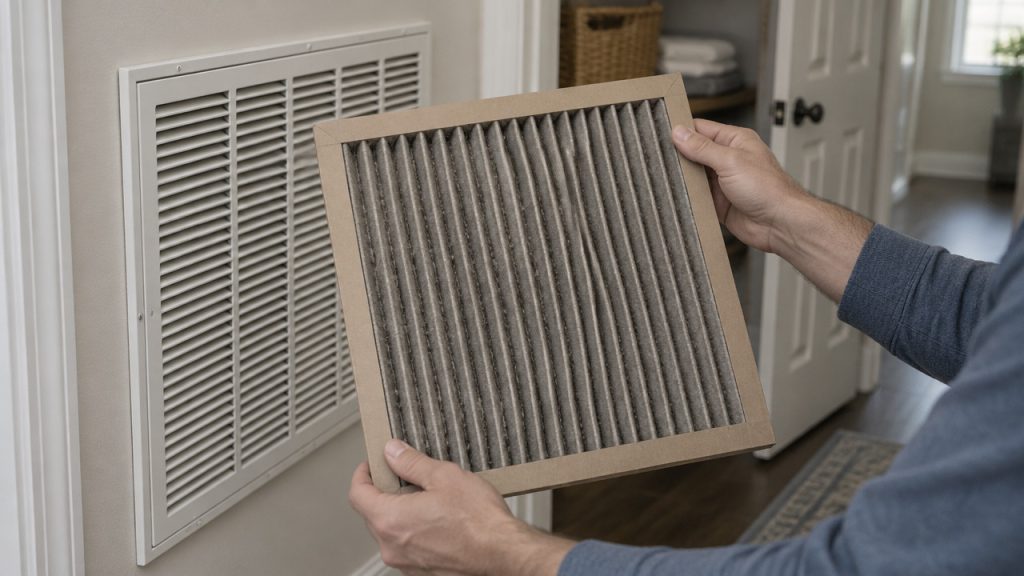
Cleaning an AC unit filter takes about ten minutes: switch off the system, slide the filter out, vacuum or rinse it, let it dry completely, and reseat it facing the right direction. In Central Texas, where summer air conditioners run nearly nonstop, that small chore decides whether your home breathes easy or your system wheezes. Skip it, and dust, pollen, and pet dander go straight into your coils, your lungs, and your electric bill.
Quick Answer: Cleaning an AC Unit Filter Is a Ten-Minute Job You Should Do Monthly in Austin
Let’s be real you don’t need an engineering degree to handle this. Cleaning an AC unit filter is straightforward maintenance that saves you money and keeps your indoor air breathable. The whole process takes about as long as scrolling through your social media feed, but the payoff is way better. You get better airflow, lower energy bills, and fewer allergens floating around your living room.
In Austin, our air conditioners work overtime, typically running from April straight through October. That kind of usage demands a more aggressive maintenance schedule than what the filter packaging suggests. Those “90-day” recommendations? They’re written for homeowners in milder climates, not for folks dealing with Texas heat and relentless cedar pollen. For local homeowners, inspecting your filter every 30 days during peak cooling season is the smart play. Catching a clog early prevents a cascade of problems that hit your wallet and your sinuses.
If you’ve noticed more dust than usual or your system sounds like it’s struggling, you might be seeing signs your home needs air duct cleaning. But let’s start with the filter itself.
- Power down the HVAC system at the thermostat and breaker for safety.
- Locate and remove the filter from the return air grille or air handler.
- Remove loose debris by vacuuming the filter or tapping it gently.
- Wash if washable with lukewarm water and mild soap; otherwise, replace.
- Ensure it is 100% dry before reinserting to prevent mold growth.
Why Central Texas Dust, Cedar Pollen, and Pet Dander Choke a Filter Faster Than the Label Promises
Living in Austin means enjoying live music, great food, and some of the most aggressive pollen counts in the country. If you suffer from cedar fever, you already know the drill. What you might not realize is that your HVAC filter is the first line of defense for your home’s respiratory system. When that filter saturates with particulate matter, the consequences go beyond just “dusty air.”
A clogged filter creates a bottleneck. Your air handler has to work harder to pull air through the blockage, which increases static pressure inside your ductwork. High static pressure strains your blower motor, shortens its lifespan, and can actually cause your evaporator coils to freeze up. When that happens, you’re not cooling your home you’re just pumping refrigerant through a block of ice and watching your energy meter spin faster.
For parents with babies or family members dealing with allergies, this is critical. A choked filter stops catching contaminants effectively. Instead, it becomes a breeding ground for the very particles you’re trying to trap. why regular duct cleaning is essential becomes obvious when you consider that a dirty filter can shed accumulated debris directly into your ductwork, circulating it through every room in your house.
Here are the most common symptoms that your filter is past its prime and restricting your system’s performance:
- Reduced airflow from supply registers, making rooms feel stuffy.
- Unexplained spike in electricity bills despite no change in usage habits.
- Visible dust buildup on vent covers or floating in sunbeams inside the home.
- Allergy flare-ups or worsening respiratory symptoms among family members.
- Warm air blowing from vents because the system is working inefficiently.
The Step-by-Step Method for Cleaning a Washable AC Filter Without Wrecking It
So you have a reusable filter great choice for sustainability. But cleaning it the wrong way can actually damage the filter media or, worse, introduce mold into your system. The goal is to remove the trapped particulate matter without destroying the structural integrity of the filter. Grab a vacuum, a garden hose, and let’s get to work. This method works for most washable residential filters, though window AC filter cleaning follows similar principles on a smaller scale.
Before you start, make sure you understand the difference between a washable filter and a disposable one. If your filter has a cardboard frame, it’s disposable don’t get it wet. If it’s a plastic or metal frame with a mesh or foam media, it’s likely washable. When in doubt, check the manufacturer’s label. And for a deeper dive into maintaining your entire HVAC system, check out this homeowner’s guide to effective duct cleaning.
Follow these steps carefully to ensure your reusable air filter cleaning process goes smoothly:
- Turn off power to the unit at the breaker panel. Never work on a live HVAC system.
- Remove the filter carefully, noting the direction of the airflow arrow on the frame.
- Vacuum the filter first using a soft brush attachment to capture loose dust and pet hair.
- Rinse with lukewarm water in a sink or with a garden hose, flowing opposite to the normal air direction.
- Wash with mild dish soap if greasy residue is present, but avoid harsh chemicals or scrubbing brushes.
- Shake off excess water and let the filter air dry completely in a well-ventilated area this is non-negotiable.
- Reinstall the filter once it is 100 percent dry, ensuring the airflow arrow points toward the blower.
Warning: Never reinstall a damp filter. Trapped moisture creates a perfect environment for mold and mildew, which will then be circulated throughout your home. Also, using hot water can warp plastic frames and damage the adhesive bonds on some filter media. Stick to lukewarm or cool water.
Washable, Disposable, or Pleated MERV: Which Filter Deserves a Spot in Your Austin Home
Walk down the HVAC aisle at any hardware store and the options can be overwhelming. Cheap fiberglass screens, pleated electrostatic filters, heavy-duty HEPA panels it’s a lot. For Austin homeowners, the choice involves balancing indoor air quality with system performance. You want a filter that catches the cedar and dust without choking your air handler.
The key metric here is the Minimum Efficiency Reporting Value (MERV). This rating scale runs from 1 to 20 and measures how effectively a filter captures particles between 0.3 and 10 microns. For most residential homes in Central Texas, a MERV 8 to 13 range hits the sweet spot. Filters rated below MERV 8 let too much dust pass through, which gums up your coils. Filters rated above MERV 13 can be too restrictive for older or smaller systems, reducing airflow and causing efficiency issues.
Consider your specific situation. If you have pets, a MERV 11 or 13 pleated filter does a better job of trapping dander. If you have a newer, high-velocity HVAC system, you have more flexibility. If your system is older, consult an HVAC technician before upgrading to a high-MERV filter. For more context on how filters integrate with your whole-home air quality system, check out our comprehensive guide to air duct cleaning.
Here is a breakdown of common filter types available to Austin homeowners:
| Filter Type | MERV Range | Cleaning/Replacement Needs | Approx. Cost | Best For |
|---|---|---|---|---|
| Fiberglass Panel | 1-4 | Replace monthly | $2-$5 | Basic dust control only; not for allergy sufferers |
| Pleated Disposable | 8-13 | Replace every 60-90 days | $10-$25 | Standard homes with pets or mild allergies |
| Washable/Reusable | 4-9 | Clean monthly; replace every few years | $30-$60 initial | Environmentally conscious owners; lower dust loads |
| Electrostatic | 10-13 | Washable; high efficiency with low airflow restriction | $20-$50 initial | High-dust environments; pet owners |
| HEPA | 17-20 | Replace annually; requires special housing | $80-$150 | Severe allergies, respiratory conditions |
Five Filter-Cleaning Mistakes That Quietly Raise Your Electric Bill and Invite Mold
We all want to be good homeowners. You might even be ambitious enough to tackle a deep clean of your filter. But sometimes, good intentions lead to bad outcomes. We have seen it all from filters scrubbed with wire brushes to filters hosed down and reinstalled while still dripping. These mistakes are insidious because they don’t cause immediate failure. Instead, they degrade your system’s efficiency over time and can create indoor air quality problems that are hard to trace back to the source.
One of the biggest issues we see in Austin homes is restricted airflow caused by incompatible upgrades. A homeowner installs a super-high-MERV filter thinking they are getting better air, but their older system simply cannot pull enough air through the dense media. The result? The system works harder, consumes more energy, and the evaporator coil gets colder and colder until it freezes solid. That ice blocks airflow completely and can damage the compressor. Maintaining your HVAC system also means knowing when other parts need attention dryer vent cleaning is another commonly neglected task that affects home safety and efficiency.
Here are five common filter maintenance errors and how to fix them:
- Reinstalling a damp filter: Mold grows fast in dark, damp ductwork. Fix: Let the filter air dry for several hours before putting it back.
- Ignoring the airflow arrow: Installing a filter backward reduces efficiency and can cause filter collapse. Fix: Always point the arrow toward the air handler.
- Using the wrong MERV rating: Too high can strangle airflow; too low lets dust pass. Fix: Stick to MERV 8-13 unless an HVAC pro advised otherwise.
- Skip the frame check: A bent or warped filter frame lets dust bypass the filter entirely. Fix: Inspect the frame for gaps and replace the filter if it’s damaged.
- Vacuuming with a beater bar: Rotating brushes can tear delicate filter media. Fix: Use a soft brush attachment or suction only.
When a Spotless Filter Still Isn’t Enough: Signs the Problem Has Moved Into Your Ductwork
You are doing everything right. You check your filter monthly, you replace it on schedule, and you keep a clean home. Yet you are still seeing dust accumulate on your furniture faster than you can wipe it off, or there is a persistent musty smell every time the AC kicks on. When your HVAC filter maintenance is perfect but the symptoms persist, the issue is likely not the filter anymore it is what lies beyond it. Your supply and return ductwork can accumulate years of debris that a simple filter change cannot fix.
This is especially common in older Austin homes where ductwork might have gone decades without a professional inspection. Over time, dust settles in the ducts, elbows, and plenums. If there are any leaks in the ductwork, the system might actually be pulling in dust from your attic or crawlspace, bypassing the filter entirely. When you seal and clean your ducts, you are not just addressing the symptom; you are fixing the system at the source.
Noble Air offers professional air duct cleaning service in Austin that tackles this deep-seated grime. For $159 per unit, homeowners receive a thorough cleaning that includes camera inspection, an air leak check, and an airflow verification. We use negative air pressure equipment to ensure contaminants are removed safely without being blown back into your living space. It is a comprehensive solution for when the DIY approach just is not cutting it.
Here are four signals that your ductwork needs professional intervention:
- Visible dust clouds puffing out of vents when the system starts.
- Uneven cooling with some rooms never reaching the set temperature.
- Persistent musty or stale odors that worsen when the fan runs.
- Rapid dust accumulation on surfaces shortly after cleaning.
Key Takeaways: Your Filter Is the Cheapest Insurance Policy Your HVAC System Will Ever Have
Think about it a quality air filter costs less than a dinner out, yet it protects your entire HVAC investment. It safeguards your coils from fouling, keeps your indoor air quality high, and ensures your system runs at peak efficiency. In a climate like Austin’s, where air conditioning is not a luxury but a necessity, that small piece of mesh or pleated fabric does a heroic amount of work. Regular HVAC filter maintenance is the single most effective thing you can do to extend the life of your equipment.
But a filter cannot do it all alone. It needs to be the right type for your system, installed correctly, and changed or cleaned on a schedule that matches your lifestyle. If you have shedding pets, you might need to check it every few weeks. If you are running construction in your home, you might need to change it daily. And remember the filter and your ductwork work as a team. When both are clean, your air is clean. To learn more about the long-term benefits of a holistic approach, explore the benefits of regular duct cleaning.
Here are the key takeaways to remember:
- Check your filter monthly during Austin’s cooling season; replace or clean every 30-90 days.
- Dry washable filters completely before reinstalling to prevent mold and mildew.
- Choose MERV 8-13 filters for the best balance of air quality and airflow efficiency.
- Install filters facing the right direction; the arrow points toward the blower.
- Combine filter care with duct cleaning for optimal indoor air quality and system longevity.
FAQ: Straight Answers on Cleaning AC Filters, Cleaning Frequency, and Pro Help
How often should I clean my AC filter in Austin?
Monthly. During peak summer months, local HVAC professionals recommend checking your filter every 30 days because Austin’s high pollen counts accelerate buildup. Waiting the standard 90 days can reduce system efficiency and strain components.
Can I just vacuum my AC filter instead of washing it?
Yes, but cautiously. Vacuuming works for removing surface dust on disposable or reusable filters between deep cleanings. However, use a soft brush attachment to avoid tearing the filter media.
Is it safe to run my AC without a filter for one night?
No. Running your system without a filter even briefly allows dust and debris to coat the evaporator coils, reducing efficiency and potentially causing expensive damage. It also degrades indoor air quality immediately.
What happens if I put a washable AC filter in wet?
Mold growth is likely. A damp filter in a dark, cool duct creates an ideal environment for mold spores to colonize within 24-48 hours. Those spores then circulate through your home, triggering allergies and respiratory issues.
Should I clean my own ducts or hire a professional?
Hire a professional. While you can handle filter maintenance, duct cleaning requires specialized equipment like negative air pressure machines and rotary brushes. DIY attempts often dislodge dust without removing it, actually making indoor air quality worse. For a deeper look, read about how to clean air ducts yourself or hire a professional.